
If you are running a business or just trying to understand how money works in a company, you have likely come across the term gross profit formula quite often. It is one of those basic things that sounds simple but actually tells you a whole lot about whether a business is healthy or if it is just burning through cash.
Basically, the gross profit formula is the first real test of a product’s success. If you cannot make money after just looking at the direct costs, then you are going to have a hard time paying for everything else like rent or staff. In this guide, we are going to look at what this financial metric really means and how you can use it to keep your business on the right track.
What exactly is the gross profit margin?
A lot of people get confused between profit and margin. To keep it simple, the gross profit margin is a percentage that shows how much money is left over from sales after you have paid the cost of sales. It is a very important financial metric because it shows efficiency.
If your gross profit margin is high, it means you are keeping a large chunk of every dollar you bring in. If it is low, it might mean your cost of sales is too high or maybe you are not charging enough. You want to see a healthy gross margin because that is what pays for your operating costs later on down the line. When we talk about gross profitability, we are really looking at how well a company manages its production process.
Formula for Calculating Gross Profit
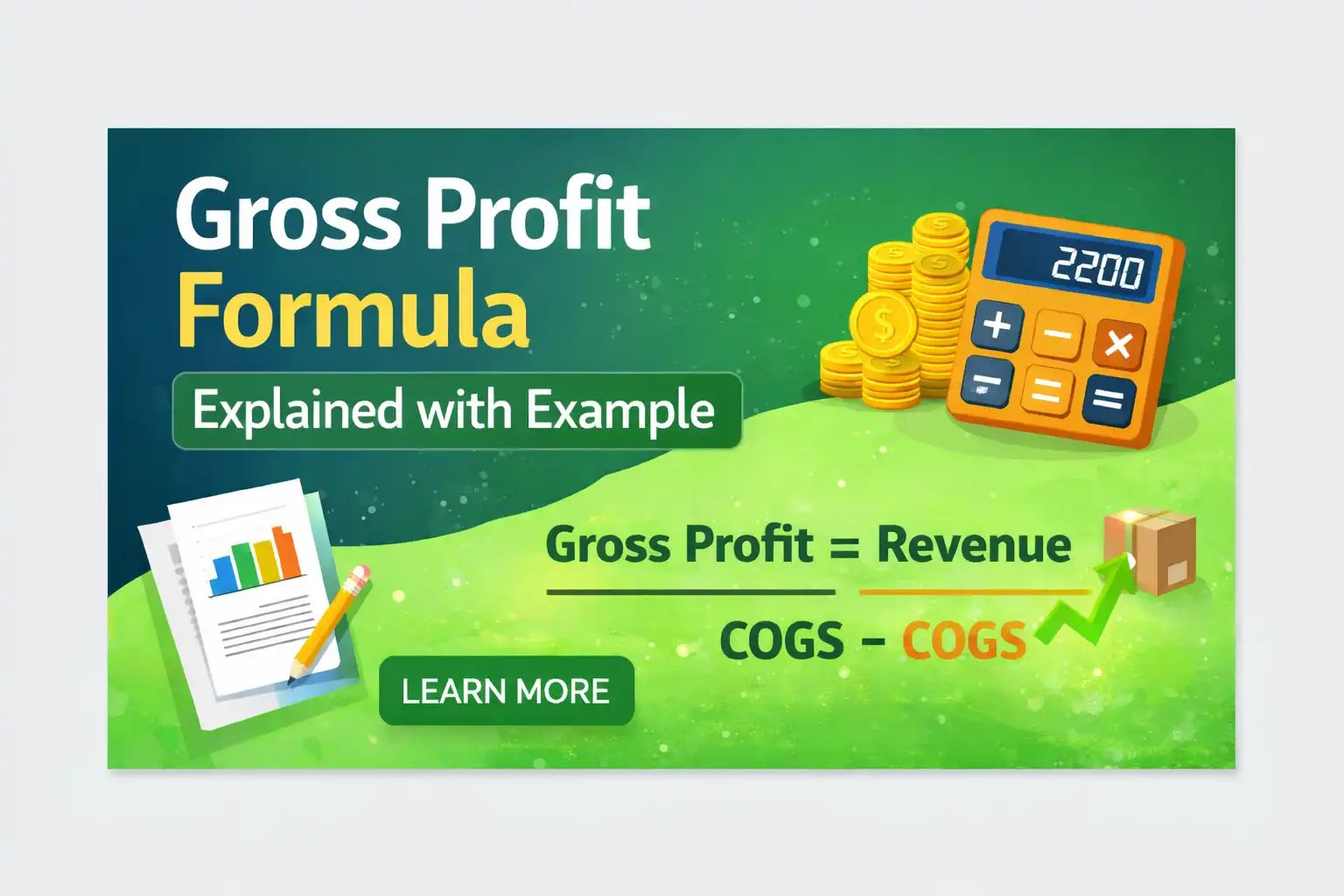
Now let us get into the actual gross profit formula itself, to find the amount, you take your total revenue and subtract the cost of goods sold, So the gross profit formula looks like this: Gross Profit equals Revenue minus Cost of Goods Sold. You might also hear people call cost of goods sold by the abbreviation cog cost of goods.
This simple gross profit formula tells you the raw dollar amount you have made. It is the starting point for almost every income statement you will ever read. Without using the gross profit formula, you are basically flying blind in your business. You need to know this number to understand your gross profitability and to see if your cash sales are actually doing what they are supposed to do for the bottom line.
What is Sales Revenue?
Definition: Sales revenue represents the total money a business generates from its primary activities, including both cash sales and credit sales.
Income Statement Position: It is typically found at the very top of the income statement, acting as the starting point for profit calculations.
Net Sales Importance: To use the gross profit formula accurately, you must use “net sales,” which means subtracting returns, discounts, and allowances from the total.
Revenue Accuracy: If a customer returns a product, that amount must be removed from the revenue figure to reflect true earnings.
Relationship with Profitability: Tracking revenue helps identify trends; for instance, if revenue grows but gross profitability drops, it often indicates that the cost of sales is rising too fast.
What is Cost of Goods Sold?
The second part of the gross profit formula is the cost of goods sold, often just called COGS or cog cost of goods. These are the direct costs tied to making your products. This includes the raw materials, the labor that actually touched the product, and factory overhead. It does not include things like the office light bill or the marketing team’s salaries.
Those are operating costs. When you are calculating the gross profit formula, you only care about the expenses that go directly into the item sold. If you sell a coffee, the cog cost of goods would be the beans, the milk, the cup, and the wage of the barista for those few minutes. Tracking your cog cost of goods is vital for maintaining a strong financial metric.
Gross Margin
As we mentioned briefly before, the gross margin is the percentage version of the gross profit formula. While gross profit gives you a dollar amount, the gross margin tells you the ratio. You calculate it by taking the result of your gross profit formula and dividing it by the total revenue, then multiplying by one hundred. This makes it much easier to compare different companies. A small lemonade stand and a giant soda corporation can both have a fifty percent gross margin even if their actual dollar amounts are worlds apart. It is a key indicator of gross profitability across different industries.
How to Find Gross Profit on the Income Statement?
If you pick up a company’s annual report, you will want to look at the income statement. This document is like a report card for the company’s finances. Usually, right at the top, you will see Revenue. Just below that, you will see the cost of sales or cog cost of goods. When you subtract the second from the first, the result listed there is the gross profit. This is the first time the gross profit formula is applied in the accounting process. It is the foundation for the rest of the income statement because all other operating costs are subtracted from this number to eventually reach the net profit.
How to Forecast Gross Profit?
Predicting the future is hard, but businesses have to do it to survive, To forecast using the gross profit formula, you have to estimate your future sales and your future cog cost of goods. You look at market trends, your past performance, and any changes in the economy. If you think the price of raw materials will go up, your gross profit formula result will likely go down unless you raise your prices. Forecasting helps you plan for the future and ensures your gross profitability stays where it needs to be to cover your upcoming operating costs.
Historical Income Statement Data
One of the best ways to forecast is to look at your old records. By analyzing your historical income statement data, you can see patterns. Maybe your cash sales always spike in December, or perhaps your cost of sales goes up every summer. Using the gross profit formula on past years helps you set a baseline. If you know that your gross margin has averaged forty percent for five years, it is a safe bet for your future planning, unless something big changes in your industry.
Gross Profit Analysis Per Division Example
If you have a big company with different departments, you should apply the gross profit formula to each one separately. For example, a company might sell both hardware and software. The hardware might have a high cog cost of goods and a low gross margin. Meanwhile, the software might have almost no cost of sales and a very high gross profitability. By breaking it down, you can see which part of the business is actually making the most money. This kind of financial metric analysis allows you to put your resources where they work the best.
5 ways to improve gross profit margin
If you find that your gross profit formula results are looking a bit slim, you do not have to just sit there and take it. There are ways to beef up those numbers. Improving your gross profitability is often about small changes that add up to a big difference. Here are five ways to get that gross margin moving in the right direction.
Change your pricing strategy
The most direct way to change the outcome of the gross profit formula is to change your prices. If you raise your prices and people keep buying, your revenue goes up while your cog cost of goods stays the same. This immediately increases your gross profitability and Sometimes a small, steady increase is better than one big jump that makes everyone angry.
Focus on value, not just cost
Instead of just trying to be the cheapest option, try to be the best, if customers feel they are getting a lot of value, they are less worried about the price. This allows you to maintain a higher gross margin because you are not stuck in a “race to the bottom” with competitors. High value often leads to better cash sales and a stronger financial metric overall. If you can justify your price through quality, your gross profit formula will reflect that success.
Optimize your product mix
Not all products perform the same, as some may give strong results from the gross profit formula while others hardly cover their cost of sales. By focusing more on high margin items and reducing on products, you can improve your product mix and increase your overall gross margin.
Implement upselling and cross-selling
When a customer is already buying something, it is the perfect time to offer them something else. Upselling is getting them to buy a more expensive version, and cross-selling is getting them to buy a related item. This increases your revenue per customer without necessarily increasing your operating costs by much. Since the customer is already there, the extra revenue usually helps your gross profit formula look much better at the end of the month.
Control discounting better
Discounts are a double-edged sword. They can bring in cash sales, but they eat away at your gross profitability very fast. If you are always running a thirty percent off sale, your gross profit formula is going to suffer. You need to make sure that discounts are used strategically and not just as a crutch because you are afraid people will not pay full price. Keeping a tight lid on discounts is a great way to protect your gross margin.
Gross Profit Calculation Example
Let us walk through a simple real life example to see how the gross profit formula works. Imagine a company called “Best Bicycles.” In one month, they had total revenue of fifty thousand dollars and the cost of sales for those bicycles, including the frames, tires, and the assembly labor, came to thirty thousand dollars.
To find the result, we use our gross profit formula: Fifty thousand minus thirty thousand equals twenty thousand dollars, So their gross profit is twenty thousand dollars. If we want the gross margin, we take that twenty thousand, divide it by fifty thousand, and get forty percent. This means for every dollar they make in cash sales, they keep forty cents after paying for the bikes themselves. They still have to pay for their shop rent and advertising out of that forty cents, which are their operating costs.
Why is measuring gross profit margin important?
Measuring this is vital because it is the “canary in the coal mine” for a business. If your gross profit formula starts showing lower and lower numbers, you know something is wrong long before the business actually runs out of money. It helps you understand if your production is getting too expensive or if your prices are too low. It is a fundamental financial metric that investors and bank managers look at to see if a company is worth their time. Without a healthy gross profitability, a company cannot survive for long because it will not have enough left over to cover its other bills.
Examples of gross profit margin
Different industries have very different standards for what a good gross margin looks like. A grocery store might have a very low gross margin, maybe only ten or fifteen percent, because they sell a huge volume of goods with a very high cost of sales.
On the other hand, a software company might have a gross margin of eighty or ninety percent because once the software is written, the cog cost of goods to sell it to one more person is almost zero. When you use the gross profit formula to compare companies, make sure you are looking at others in the same industry. Comparing a restaurant’s gross profitability to a consulting firm’s financial metric is not going to tell you much that is useful.
Conclusion
At the end of the day, the gross profit formula is one of the most useful tools any business owner or student of finance can have in their pocket. It is the simplest way to see if the core idea of a business is actually making money. By subtracting the cog cost of goods from your revenue, you get a clear picture of your gross profitability. Whether you are looking at an income statement or trying to improve your cash sales, keeping a close eye on your gross margin will help you make better decisions. Remember that while the gross profit formula is just the start, it is the foundation upon which everything else in a business is built.
FAQ
What is the gross profit formula?
The gross profit formula is quite simple, You just take your total revenue and subtract the cost of goods sold. The result you get is your gross profit. It is usually the first profit figure you will see on an income statement.
What is the formula for gross profit in Class 12?
For students in Class 12, the gross profit formula is often taught as: Gross Profit = Net Sales – Cost of Goods Sold. Net Sales is calculated by taking total sales and subtracting sales returns. Cost of Goods Sold is usually calculated as Opening Stock + Purchases + Direct Expenses – Closing Stock.
What is the GP ratio formula?
The GP ratio formula, which stands for Gross Profit ratio, is another way of saying gross margin. To find it, you take the result from your gross profit formula, divide it by Net Sales, and then multiply by one hundred to get a percentage. This helps people see the gross profitability as a percentage of the total revenue.
Which formula correctly calculates gross profit?
The most accurate formula is Gross Profit = Revenue – COGS. Just make sure that when you are looking at revenue, you are using the net figure after any returns or discounts have been taken out. Also, ensure your COGS only includes direct costs and not general operating costs like rent or office salaries.
How is gross profit different from net profit?
Gross profit only focus on the direct cost of sales, while net profit is what is left after you have taken the gross profit and then subtracted all other expenses, like operating costs, interest, and taxes. The gross profit formula is the first step, and the net profit is the final step of the calculation on the income statement.
Can a company have a negative gross profit?
Yes, it is possible, though it is a very bad sign. This happens if the cost of sales is actually higher than the revenue. It means the company is losing money on every single item it sells, even before it pays for its other operating costs. Usually, a company in this position needs to change its pricing or find a way to lower its cog cost of goods immediately.
Where do I find the gross profit formula in Excel?
There is not a specific “button” for it, but you can easily set it up. If your Revenue is in cell A1 and your Cost of Goods Sold is in cell B1, you would just type =A1-B1 into cell C1. That is your gross profit formula in action. To get the margin, you could type =(C1/A1)*100 in another cell. It is a very basic but powerful way to track your financial metric.