
Understanding the interest coverage ratio is essential when you are looking at a business to see if it is truly healthy or just pretending to be. You simply have to look at how it handles its debt. This vital financial metric basically tells you if a company can pay the interest on its outstanding debt without breaking a sweat. To really get the full picture of financial health, you need to see it as a key profitability ratio that measures safety. This blog explores how to calculate and interpret this ratio to gauge liquidity risks effectively.
Defining the Interest Coverage Ratio (ICR)
The interest coverage ratio is a specific financial metric lenders and investors use to gauge company risk. It measures how many times earnings cover current interest bills. Often called the times interest earned ratio, it shows if a company with high outstanding debt has enough profit for payments. Using this times interest earned approach reveals if a capital asset purchase was actually a smart move.
This interest coverage ratio cuts through noise by linking profit to borrowing costs. For more on managing money, visit budget excel; budget excel has more budget-related blogs. Checking Budget Excel helps you track numbers better. A high times interest earned score is a key profitability ratio that every manager wants for their capital asset stability.
How to Calculate the ICR: The Formula
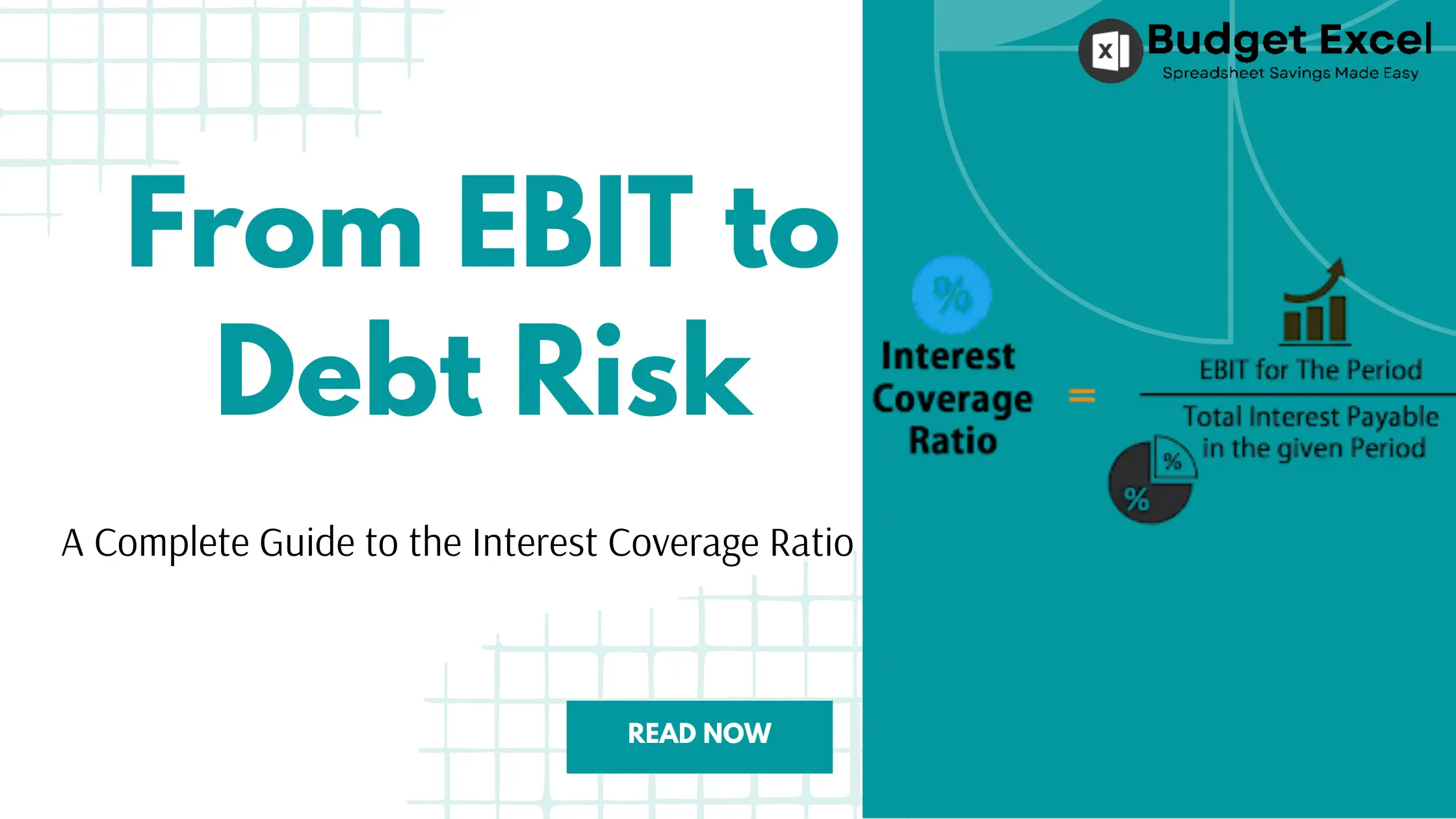
Calculating this is actually quite simple once you have the right numbers from the balance sheet and income statement. The most common way to do an interest coverage ratio calculation is to take the EBIT and divide it by the total interest expense. EBIT stands for earnings before interest and taxes. This specific profitability ratio is great because it ignores tax variations.
You take your EBIT and you divide it by the interest due on the outstanding debt for that same period. This financial metric shows how many times over the profit covers the interest. Some people like to add back depreciation and amortization to the earnings, but the standard EBIT version is what most people start with. If you have a large capital asset on the books, you will see a lot of depreciation and amortization every year.
Different Varieties of Interest Coverage Ratios
There is not just one way to look at this. While the EBIT version is popular, some analysts prefer to use EBITDA or EBIAT to get a different view of the business.
Looking at EBITDA: The Cash Flow Perspective
By including depreciation and amortization, you get a sense of the cash flow available, since those are non-cash expenses linked to a capital asset. This variation of the interest coverage ratio is often used for companies that have a lot of capital asset investments. A firm with a heavy capital asset load must track its times interest earned very carefully to avoid bankruptcy.
EBIAT Analysis: Factoring in the Tax Impact
Another type is the times interest earned ratio using EBIAT, which looks at earnings after taxes but before interest. When you are looking at a company with heavy capital asset requirements, you might find that their EBIT is low because of high depreciation and amortization, so the ratio looks worse than it actually is. This is why looking at different versions of the interest coverage ratio is smart. You want to see the full liquidity risks before making a judgment on a capital asset intensive business. A true profitability ratio should account for these differences.
ICR in Action: A Practical Example
Let us say we have a company called Big Tech Corp. They have an EBIT of $500,000 for the year. To find the interest coverage ratio, you just do $500,000 divided by their outstanding debt interest of $100,000. That gives you a result of 5. This times interest earned result is very strong for a company with a massive capital asset base.
A result of 5 is generally considered quite safe. However, if their interest expense was $400,000, their interest coverage ratio would only be 1.25. This shows they have very little room for error if their EBIT drops. It shows they are facing serious liquidity risks if the market turns bad. A weak times interest earned number often means you cannot afford another capital asset.
Making Sense of Your ICR Results
So, what do these numbers actually tell us? If the interest coverage ratio is below 1, the company is in big trouble as they are not making enough EBIT to pay interest. This is a sign of extreme liquidity risks. They would have to use cash reserves or sell a capital asset to pay the bank. Selling a capital asset just to pay interest is a desperate move that hurts the times interest earned long term.
On the other hand, a high interest coverage ratio suggests the company is very stable. But if the ratio is too high, it might mean they are not using enough debt to buy a new capital asset to grow. Most analysts do a trend analysis to see if the interest coverage ratio is getting better or worse over time. A trend analysis is much more useful than looking at one single snapshot and can predict future liquidity risks.
Key Applications for the Interest Coverage Ratio
This financial metric is used everywhere in the professional world. Banks use it before giving out loans, and investors use it to avoid companies that might go bankrupt. It is essentially a profitability ratio that focuses on debt survival. When you calculate times interest earned, you are checking if the company can afford its outstanding debt.
When a company wants to buy a new capital asset, they might need to take on more outstanding debt. Before doing that, they should check their interest coverage ratio to ensure they can handle the new payments. Adding more debt to buy a capital asset when the current ratio is low would be a terrible idea. Also, credit departments use trend analysis to keep an eye on existing clients. A strong profitability ratio usually leads to a better times interest earned result.
Potential Drawbacks of Using ICR
No number is perfect, and the interest coverage ratio has its limits. One problem is that EBIT does not always equal cash, which can hide real liquidity risks. Even if the times interest earned looks good on paper, the cash might not be there if customers have not paid their bills.
Another issue is that the ratio ignores principal payments of outstanding debt, only focusing on interest. If a company has a huge balloon payment coming up for a capital asset, the interest coverage ratio might look fine even as the company fails. This is why a trend analysis is so important. Since standards vary by industry, a good profitability ratio for a utility might be terrible for a software startup. You must look at context and use depreciation and amortization adjustments when evaluating any capital asset.
What Number Should You Aim For?
Generally speaking, a ratio above 3 is considered decent for most businesses. If it is above 2, lenders might still be okay with it, but they will watch it closely. If the interest coverage ratio falls below 1.5, it is time to start worrying about liquidity risks. A falling times interest earned score is often the first sign of trouble in a trend analysis.
For very stable companies with predictable income, a lower ratio might be acceptable. But for volatile industries, you want a much higher interest coverage ratio to protect against a bad year. Performing a trend analysis will tell you if the company is moving toward safety or toward a crisis. Always compare the profitability ratio to other companies in the same sector. If your competitors have a better times interest earned score despite having the same capital asset load, you have work to do.
Final Summary
In the end, the interest coverage ratio is a vital tool for anyone who wants to understand business finance. It connects the EBIT of a company to the reality of its outstanding debt. By calculating this financial metric and looking at depreciation and amortization, you get a clear view of the safety margin a company has. Whether you use the standard formula or the times interest earned approach, the goal is the same, which is to spot liquidity risks before they become a disaster. Do not forget to do a trend analysis to see if that profitability ratio is sustainable. Keep an eye on how the company manages every capital asset and its outstanding debt over time.
FAQs
What is the interest coverage ratio?
It is a financial metric that shows how easily a company can pay interest on its debt using its EBIT. It is a major profitability ratio used for risk assessment.
Is a higher or lower interest coverage ratio good?
A higher ratio is almost always better because it means the company has more than enough profit to cover its interest. It suggests a high times interest earned capability. A lower ratio means the company is struggling and might face liquidity risks.
What is indicated by the interest coverage ratio?
It indicates the financial stability of a company and its ability to handle its outstanding debt. A trend analysis of this ratio shows if a company can afford its next capital asset.
What is the interest coverage ratio Class 12?
In the Class 12 accounting syllabus, it is taught as a solvency ratio. It helps students understand how to measure the long term debt paying capacity of a business by comparing EBIT to interest charges on outstanding debt. It is a fundamental profitability ratio for learners.